Most AI travel tools can suggest a hotel, compare destinations or build an itinerary. Instinct is trying to go further. The personal AI assistant is designed to complete tasks for you, including arranging transportation and handling other everyday requests, all through a text conversation or phone call.
Early users have reportedly used Instinct to book and rebook travel, monitor fares, apply airline credits and manage seat assignments. That promise has attracted plenty of attention, but Instinct is not widely available yet. The company says it is currently limited to a private-access group while it increases its computing capacity.
I contacted Instinct through iMessage and was told that I had joined the waitlist. Unless you receive an invitation from an existing user, that may be as far as you get for now.
There is another part travelers should understand before handing over access to their inboxes, calendars and booking accounts. According to Instinct’s own policies, the assistant may require access to messages, emails, calendars, location, account credentials and payment information, depending on the permissions a user grants.
That makes Instinct potentially useful, but it also creates privacy, security and booking risks that should not be brushed aside.
What is Instinct AI?
Instinct is a personal AI assistant operated by Spear Street Technology, Inc. Rather than requiring users to learn another complicated app, the service can be reached through text or a phone call.
The company says Instinct can connect to applications and devices, including email, messaging, screen activity, audio and location. It is designed to use a phone and computer to carry out tasks on a user’s behalf.
For travelers, the difference between Instinct and a standard AI itinerary generator is important. An itinerary tool may tell you which flight to book. Instinct is intended to interact with connected services and take authorized actions on the user’s behalf.
What can Instinct do for travelers?
Reporting from Skift describes early users putting Instinct to work on several parts of a trip that would normally require switching among airline websites, email, calendars and booking platforms.
- Booking and rebooking travel
- Monitoring fares for price drops
- Applying unused airline credits
- Helping keep family members seated together
- Adding trip information to calendars
- Arranging transportation to the airport
- Finding flights and managing reservations
- Following up on unfinished conversations and tasks
That is more ambitious than simply returning a list of options. However, the service remains in private access, and its reliability at a much larger consumer scale has not been established publicly.
Instinct also reaches beyond travel. The company’s founder has said early users have employed it to plan road trips, buy groceries and concert tickets, cancel subscriptions and help plan a wedding. Its broader goal is to become a personal assistant that understands what needs attention and then acts on it.
I tried to get access to Instinct
I contacted Instinct through iMessage to see how quickly a new user could begin testing it. The response confirmed that the service is working with a limited group while it increases its computing capacity and reliability.
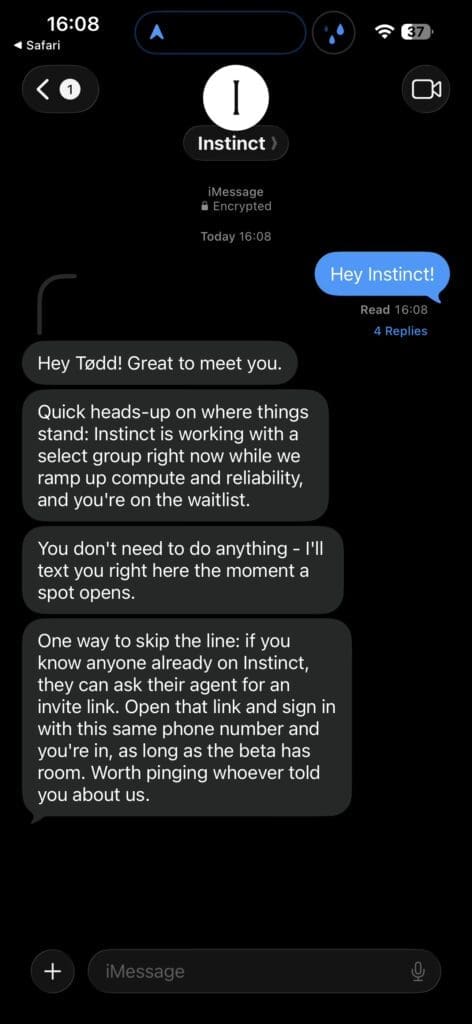
I was placed on the waitlist and told that I did not need to take any additional action. Instinct said it would contact me through the same message thread if access became available.
The message also explained that an existing member may be able to provide an invitation. This matches the access information on Instinct’s official website, which says prospective users can join the waitlist or ask an existing member for an invitation.
An invitation does not necessarily guarantee immediate access, since Instinct told me admission still depends on whether the private beta has room.
This means I have not personally tested Instinct’s booking, rebooking or fare-monitoring capabilities. Those features are based on company information and reports involving early users. I will update this article if I receive access and can put the travel functions through a proper real-world test.
How much does Instinct cost?
Instinct’s public website does not currently list standard consumer pricing. It describes the service as available to a private-access group and directs prospective users to join the waitlist or obtain an invitation.
The company’s Terms of Service include provisions for paid services, but they do not establish what Instinct will ultimately cost when access becomes more widely available.
Travelers should therefore be cautious about descriptions of Instinct as a permanently free product. Private access without a published price does not guarantee that the service will remain free.
Why Instinct matters for travel
Travel booking is still surprisingly fragmented. One trip can involve an airline website, a hotel platform, several confirmation emails, a calendar, a seat map and a separate transportation app. When something changes, the traveler may have to work backward through all of them.
An assistant that can understand the entire trip and safely make changes across those services could eliminate a meaningful amount of work. Instead of searching for a flight, copying the details and completing the booking yourself, you could give the assistant your dates, budget and preferences and ask it to handle the process.
That is the promise, but the difficult part is not producing a polished recommendation. It is completing the correct transaction at the correct price, under the correct cancellation conditions, without exposing more information or authority than necessary.
Skift documented an example involving an incorrect hotel rate and noted that even a capable assistant cannot overcome unavailable inventory or other real-world booking restrictions. Those are not small details when a mistake involves airfare, a nonrefundable hotel or a family’s seat assignments.
The privacy tradeoff travelers need to understand
Instinct can only provide this level of assistance if users allow it to see and use substantial amounts of personal information.
According to the company’s Privacy Policy, information available to the assistant may include connected emails, private messages, documents, calendar information, audio, precise location, account credentials and payment details, depending on the permissions granted by the user.
The policy says Instinct does not sell personal information or disclose it to registered data brokers. It nevertheless allows information to be used to operate, personalize and improve the service.
Certain information may also be used to evaluate, fine-tune or train AI models unless the user opts out. The policy says this opt-out applies going forward and may not affect models previously trained or improved using the information.
The company treats information obtained through Google Workspace differently. Instinct says it does not use information received from Google Workspace APIs to train or improve its AI models or serve advertising.
Anyone considering the service should read both the current Privacy Policy and Terms of Service rather than relying solely on summaries or early promotional posts.
Disconnecting an account is not the same as deleting its data
Instinct’s terms explain that disconnecting a connected service may not automatically delete information that has already been copied and indexed. Users who want that information removed must follow a separate deletion process through their Instinct workspace.
The Privacy Policy repeats this distinction. Removing a connection may stop continued access, but it does not necessarily erase everything previously collected from that integration.
Instinct may enter transactions on your behalf
The Terms of Service authorize Instinct to interact with connected services and take actions for the user. They also appoint the service as an agent that can enter certain agreements, commitments or transactions on the user’s behalf.
If Instinct makes a purchase, the user remains the buyer. The airline, hotel or other provider’s pricing, fees, cancellation and refund policies still apply, and transaction disputes generally remain between the traveler and that provider.
That authority is central to the product. It is what allows Instinct to do more than offer advice. It is also why users need to understand what the assistant can approve, purchase or change before connecting important accounts.
Users remain responsible for checking its work
Instinct’s terms place responsibility on the user for reviewing the assistant’s actions and their financial, contractual, legal or other consequences.
The terms also warn that records of actions may not always be accurate and tell users to independently verify whether an action was appropriate.
That makes sense for an experimental product, but it limits the idea of completely hands-off travel management. A traveler should still verify names, dates, airports, fare restrictions, baggage allowances, cancellation terms and the final price before treating a booking as settled.
How to use an autonomous travel assistant more safely
If Instinct opens access more widely, I would not begin by connecting every personal and financial account. A staged approach makes more sense:
- Read the current terms. Policies can change during private testing, so review the versions presented when you actually register.
- Start with a lower-risk task. Test itinerary organization or a refundable reservation before delegating an expensive international booking.
- Limit connected accounts. Provide only the access needed for the task you want completed.
- Review the training settings. Instinct provides a model-training opt-out, although the company says it applies going forward.
- Request deletion separately. Instinct’s policies state that disconnecting an account and deleting indexed information are separate steps.
- Verify every reservation. Check the confirmation directly with the airline, hotel or booking provider.
- Keep emergency contacts available. Do not rely on a private-beta assistant as your only way to reach an airline, insurer or accommodation provider.
Should travelers join the Instinct waitlist?
Joining the Instinct waitlist does not require you to connect your inbox, calendar or payment information immediately. If you are interested in travel technology, you can request access and decide later whether you are comfortable with the permissions involved.
Actually using the assistant requires a more careful decision. Instinct’s ability to complete bookings is precisely what makes it interesting, but that same ability means giving an autonomous service access to sensitive information and permission to act.
For now, I would treat Instinct as a promising private-access product rather than a proven replacement for established travel-planning and booking tools. Its real test will not be whether it can book one impressive hotel stay. It will be whether it can consistently handle prices, restrictions, changes and disruptions without creating new problems for the traveler.
I am staying on the waitlist. If an invitation arrives, I will test the service with a controlled travel task and update this article with what actually happens.
Sources
- Instinct: Official product information and private-access notice
- Instinct Privacy Policy
- Instinct Terms of Service
- Skift: A Viral AI Bot Just Showed Travel What Frictionless Actually Means
- TechCrunch: Instinct’s Powerful AI Assistant Is Raising Privacy and Security Concerns
- TechCrunch: Viral AI Startup Instinct Has Raised $350 Million at a $2.5 Billion Valuation


