First-time visitors to England will find that the most rewarding food experiences depend heavily on location and timing. A Sunday roast, Full English breakfast, fish and chips, pub meals, local cheese, afternoon tea, and traditional puddings form a practical starting point, but regional specialties matter as much as nationally recognized dishes.
Beyond the classics, eating well in England means using farm shops, markets, butchers, and harbor stalls alongside restaurants and pubs. Drinks, seafood, and cuisine shaped by immigrant communities are equally part of the picture, and kitchen hours often differ significantly from what American visitors expect.
You can come to England, eat fish and chips, have a Sunday roast, order afternoon tea and leave with a perfectly respectable introduction to English food.
But you’d also miss a lot.
I’m currently spending an extended period in England, and one of the things I’ve learned quickly is that what you should eat depends heavily on where you’re going. The food I look for around Bath and Somerset isn’t necessarily what I’d prioritize in Cornwall, Yorkshire, Cumbria or London.
So this isn’t meant to be a checklist of every traditional English dish. It’s the travel version: what I’d make room for on a first trip, where I’d look for it and when I’d skip the famous version in favor of something more local.
Looking beyond England? Start with my What to Eat in Britain guide for the bigger picture across England, Scotland and Wales.
Short Version: What I’d Eat on a First Trip
I’d make room for a Sunday roast, fish and chips, a Full English breakfast, one good pub meal, local English cheese, afternoon tea or cream tea, something from a bakery and at least one traditional pudding. After that, I’d stop working from a national checklist and start looking for whatever the town or region I’m visiting is known for.
If It’s Sunday, Plan Around the Roast
If my trip includes a Sunday, this is the meal I’d plan around rather than trying to squeeze it in between sightseeing stops.
Sunday roast is widely available, but that doesn’t mean I’d walk into the first pub advertising one. If I’m going to devote a couple of hours to lunch, I want somewhere that has a reputation for doing it well.
Beef, lamb, pork and chicken are common, usually accompanied by roast potatoes, vegetables, gravy and, very often, Yorkshire pudding.
The practical part matters: book ahead. Popular pubs can fill for Sunday lunch, and some kitchens stop serving earlier than an American visitor might expect.
I wouldn’t leave this until 1:00 Sunday afternoon and then start searching for the “best Sunday roast near me.”
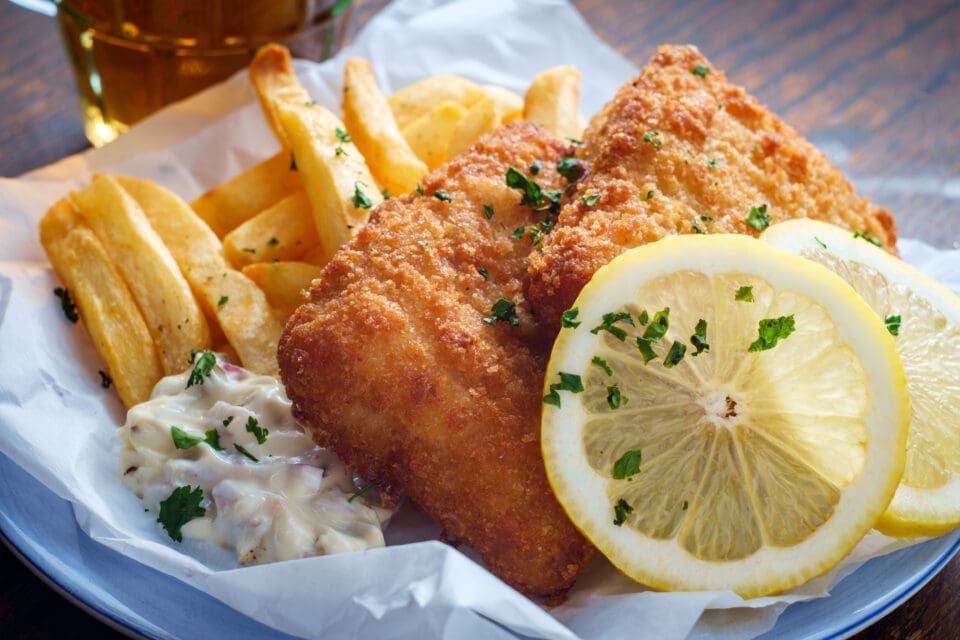
Have Fish and Chips, but Think About Where You Order It
Fish and chips is one of the foods almost everyone associates with England, so yes, I’d have it.
A pub or hotel isn’t necessarily where I’d order it, either.
If I’m near the coast, I’m looking first for a busy independent fish and chip shop, a harbor-side place or somewhere making a point of serving locally landed fish.
And there’s something to be said for getting it as takeaway and eating it outside near the water rather than turning every traditional food into a sit-down restaurant experience.
Cod and haddock are common. Add salt and malt vinegar, then decide whether you’re joining the mushy peas, curry sauce or tartar sauce camp.
Eat in Pubs
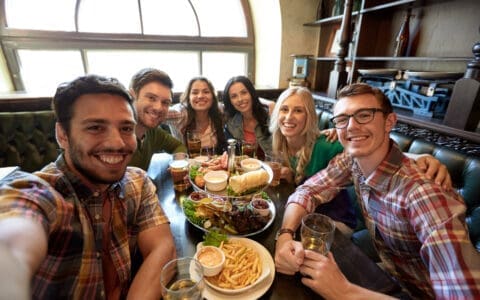
If you’re trying to work traditional English food into a trip without making every meal another reservation, pubs make life considerably easier.
Steak and ale pie, bangers and mash, fish and chips, Ploughman’s lunch, Scotch eggs, fish pie and ham, egg and chips are all worth knowing.
Cumberland and Lincolnshire are two names you’ll see, but independent butchers all over England make their own. If a menu tells me where its sausages came from, that’s usually the version I’m ordering.
But after spending more time eating in pubs here, I’m less interested in whether a menu has every famous pub dish and more interested in what that particular pub seems to care about.
If the sausages come from a butcher down the road, the pie uses beer from a nearby brewery or the Ploughman’s features a local cheese, that’s usually where I’m looking first.
Before you order: Foodie & Wine’s British Pub Food Guide covers the individual dishes in much more detail.
Know How the Pub Works Before You Sit Down
It took me a little time to get used to how ordering works in British pubs because there isn’t one standard system.
- Some pubs have full table service.
- Some expect you to find your own table and order at the bar.
- You may need your table number before ordering.
- Larger pubs may use QR codes or apps.
- A chalkboard may have specials that aren’t on the printed menu.
If there’s a “Please Wait to Be Seated” sign, wait. If there isn’t, look around and see what everyone else is doing. And if you’re still not sure, ask.

Check the Kitchen Hours, Not Just the Pub Hours
This is particularly important for American visitors.
A pub can be open and happily serving drinks while its kitchen is completely closed. Food service may stop after lunch and start again at dinner, and smaller pubs can keep much shorter kitchen hours than you’d expect in the U.S.
I’m currently based in Bath, and Sundays have been the biggest adjustment. Plenty of restaurants and pub kitchens stop serving around 7:30 or 8:00 p.m., which feels early when you’re used to being able to sit down for dinner closer to 10:00 p.m. back in the U.S.
If I’m making a special trip somewhere because I want to eat there, I always check the kitchen hours separately.
Have a Full English Breakfast Once
A Full English is worth doing at least once. You probably won’t need lunch immediately afterward.
The plate varies, but expect some combination of bacon, sausage, eggs, baked beans, tomatoes, mushrooms, toast and black pudding. Hash browns and fried bread may show up too.
I’d look for an independent café, pub or B&B rather than making the hotel buffet my default.

Try a Pie, Pasty or Sausage Roll
You could spend an unreasonable amount of a trip eating British savory pastry, and I wouldn’t necessarily discourage it.
Steak and ale pie is one of my pub favorites. If you’re in Cornwall, I’d make a point of having a Cornish pasty there. Pork pies are worth trying too, particularly if you’re traveling around Leicestershire.
And then there are sausage rolls. They’re one of my absolute favorites and exactly the sort of thing I’d rather pick up from a good butcher or bakery than buy as a generic grab-and-go snack.
Want the differences? Foodie & Wine’s British Pies and Pasties Guide covers steak and ale pie, pork pies, Cornish pasties, sausage rolls and the regional styles in much more detail.
Try the Cheese Where It’s Made
England’s cheese is easy to miss when you’re concentrating on pub meals.
I’m currently based in Bath, so Somerset and the wider West Country have made this particularly hard for me to ignore. Cheddar is the obvious name, but I’m less interested in memorizing a list of English cheeses than finding out what’s actually made near where I’m staying.
Farm shops, markets and independent cheesemongers are ideal for this. A Ploughman’s lunch at a pub is another easy way in, particularly when the menu names the cheese rather than simply saying “Cheddar.”
Afternoon Tea Doesn’t Have to Mean a Luxury Hotel
Afternoon tea is one of those experiences that’s easy to turn into a major production.
If that’s what you want, England has no shortage of beautiful hotels serving elaborate versions. But you don’t have to spend a fortune to have tea, sandwiches, scones and cakes.
Independent tearooms can be more relaxed, and sometimes all I really want is a cream tea: a warm scone, clotted cream, jam and tea.
And Yes, There’s an Order for the Jam and Cream
If you’re in Cornwall, the traditional order is jam followed by clotted cream. In Devon, it’s cream followed by jam.
I suggest trying both and avoiding any attempt to settle the matter permanently.

Let the Coast Decide What You Eat
If I’m near the coast, seafood moves much higher up my list.
Rather than deciding in advance that I’m going to eat the same fish everywhere, I’d ask what’s local or in season.
| Where | What to Look For |
|---|---|
| Cromer, Norfolk | Crab |
| Whitstable, Kent | Oysters |
| Cornwall | Crab, mussels, sardines and locally landed fish |
| Devon | Crab, scallops, mussels and local fish |
| Northumberland | Smoked fish and kippers |
Fishmongers, harbor stalls and simple seafood cafés are all worth checking. Not every memorable food stop needs a reservation.
Save Room for Pudding
One useful translation before you order: pudding can simply mean dessert in England. It can also refer to a particular sweet or savory dish.
Sticky toffee pudding, fruit crumble, bread and butter pudding, Eton Mess, treacle tart and Bakewell pudding are all names worth recognizing.
But I wouldn’t work through them like a checklist. If the pub says its crumble is made with fruit from nearby or the bakery has something you’ve never seen before, I’d order that.
Want to make them at home? Foodie & Wine’s Traditional English Recipes is where I’m collecting and testing the recipes themselves.

Some of the Best Food Stops Aren’t Restaurants
This is one of the biggest changes I’d make to a food-focused England itinerary: don’t book every meal.
| Stop | What I’m Looking For |
|---|---|
| Pub | Local beer or cider, pies, sausages, Sunday roast and specials |
| Farm Shop | Cheese, meat, produce, cider, preserves and regional specialties |
| Market | Small producers and several local foods in one stop |
| Butcher | Sausages, pies and prepared foods |
| Bakery | Sausage rolls, buns, pastries, pies and regional baking |
| Cheesemonger | Whatever is actually made locally |
| Fishmonger / Harbor Stall | Local seafood |
| Tearoom | Scones, cakes and cream tea |
Some of my better finds have come from wandering into places I didn’t know existed before that day. Leaving a little room in the itinerary makes that possible.
Where I’d Go for a Food-Focused Trip
Bath and the West Country

I’m currently based in Bath, and it’s an easy place to combine actual sightseeing with food without having to build the entire trip around restaurants.
You have pubs, bakeries and restaurants in the city, then Somerset, Wiltshire, Gloucestershire and the Cotswolds within reach. Cider country, farm shops and cheese producers give you plenty of reasons to get outside Bath too.
Cornwall
I’d put Cornwall high on the list if seafood and regional food traditions are important to you. Fishing towns, bakeries and coastal stops make it easy to eat well while you’re actually seeing Cornwall rather than driving from reservation to reservation.
Yorkshire
Yorkshire gives you cities, historic towns, pubs, tearooms and countryside, so the food fits naturally into a broader trip. This is somewhere I’d particularly want a Sunday in the itinerary.
Lake District and Cumbria
This would be my choice if I wanted scenic drives, village pubs, butcher shops, bakeries and farm shops to be part of the trip rather than side stops between restaurants.
Kent and Sussex
Kent and Sussex make sense if you want to combine food with vineyards, countryside and the coast. English wine is an obvious draw, but I’d leave time for seafood, orchards and farm shops too.
London
London gives you an enormous amount in a relatively small area: historic pubs, traditional cafés, markets, bakeries, modern British restaurants and food from communities that have shaped how England eats today.
It’s a great introduction to eating in England, but it’s only one part of the picture. The food changes considerably once you start traveling through the country’s different regions.
Also worth considering: The Midlands for pork pies, Stilton and Bakewell pudding, and East Anglia for Cromer crab, coastal seafood and farm shops.
For the deeper regional food breakdown, see my Ultimate Guide to English Food on Foodie & Wine.
Don’t Spend the Entire Trip Eating “Traditional” Food
I love seeking out traditional English dishes, but that’s only one part of eating your way around England.
Curry houses, Caribbean restaurants, kebab shops, Polish bakeries, Italian cafés and restaurants representing cuisines from around the world are part of everyday life here.
Birmingham is a good example, where the Balti became closely associated with the city’s Pakistani and Kashmiri communities. London, Leicester, Bradford and Manchester have their own food scenes shaped by the communities that have made those cities home.
If every meal is roast beef, fish and chips or pie, you’re missing a big part of what eating in England actually looks like.

Drink What’s Local Too
I’ve been doing the same thing with drinks that I do with food: start by seeing what’s made nearby.
Being based in Bath puts me right next to Somerset cider country, so cider has become a go-to with pub food. Elsewhere, I’d look at the local brewery taps, cask ales or English wine rather than automatically ordering something familiar.
You don’t need to turn dinner into a complicated pairing exercise. A local cider with pork or a pint brewed down the road can be part of experiencing the place.
If you do want the pairing details: Foodie & Wine has a full collection of wine pairing guides.
English Food Terms Americans Should Know
English is still English until the menu shows up and someone offers you crisps with your sandwich.
| In England | For Americans |
|---|---|
| Chips | French fries, generally thicker |
| Crisps | Potato chips |
| Biscuit | Usually closer to what Americans would call a cookie or cracker, depending on the type |
| Jacket Potato | Baked potato |
| Mince | Ground meat |
| Pudding | Often dessert generally, but also the name of specific dishes |
| Rocket | Arugula |
| Swede | Rutabaga |
If You Only Have One Day
If I had one day to give someone a quick introduction to eating in England, I’d worry less about checking off dishes and more about changing the type of place throughout the day.
| When | What I’d Do |
|---|---|
| Breakfast | Full English at an independent café |
| Late Morning | Market, bakery or farm shop |
| Lunch | Pub meal with something local to drink |
| Afternoon | Cream tea, bakery or local cheese stop |
| Dinner | Something connected to the city or region you’re visiting |
| Pudding | Whatever looks homemade, local or seasonal |
If that one day happens to be Sunday, I’d rearrange the schedule around Sunday lunch.
Want to Know More About the Food?
Cleared for Departure covers where to find these foods, how they fit into a trip and which local food experiences are worth making room for. Foodie & Wine handles the kitchen side: what the dishes are, how they’re made and the recipes I’m testing at home.
- Ultimate Guide to English Food — the deeper guide to England’s dishes, regions and food traditions
- Traditional English Recipes — the recipes to make at home
- British Pub Food Guide — what you’ll find on a pub menu and what it’s traditionally served with
- British Pies and Pasties Guide — pies, pasties, sausage rolls and regional styles
- Steak and Ale Pie — my recipe for making the pub classic at home